Objevte destinaci Pula
Arena, Pula (Pula, Istria)
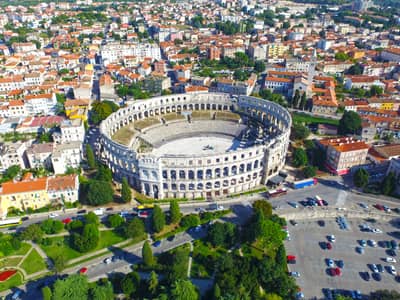
Popularly called the Arena of Pula, it was bulit in the 1st century AD during the reign of Emperor Vespasian and it became the ancient monument in the center of Pula. 3000 years ago it hosted the popular gladiator fights which took place in the central flat area called the arena, but today many summer performances take place in the same place where gladiator had fought in the Roman time. It is the 6th largest ancient amphitheater in the world. Arena info
Arch of the Sergii – Golden Gate (Pula, Istria)
Called Twin Gates because of the two arches through which you enter the inner yard, they were built between the 2nd and 3rd centuries and today they guide to the Archeological Museum and the Castle.In the ancient and medieval times the city was surrounded by the city walls and people had ten gates to enter in the center. The walls had become old and unnecessary so they were destroyed at the beginning of the 19th century. Arch of the Sergii – Golden Gate Info
The Twin Gates (Pula, Istria)
Called Twin Gates because of the two arches through which you enter the inner yard, they were built between the 2nd and 3rd centuries and today they guide to the Archeological Museum and the Castle.In the ancient and medieval times the city was surrounded by the city walls and people had ten gates to enter in the center. The walls had become old and unnecessary so they were destroyed at the beginning of the 19th century. Twin Gates Info
Forum (Pula, Istria)
Situated in the western part of Pula, Forum is the main square. During the Roman time it was the nucleous of the city and its religious, administrative, legislative and commercial center. On the northern part of the Forum stood two twin temples and a central one dedicated to Jupiter, Juno and Minerva. Today only the Temple of Augustus has been preserved. Anyway even today the Forum remains the administrative and legislative center of Pula. In the summer season it’s a place where many cultural events take place. Forum Info
National park Brioni (Brijuni) (Pula, Istria)
The only national park in Istria. Brijuni has 14 islands which present a unique play of nature that brings together remarkable animal species and rare flora.An excursion to Veli Brijun, the largest island with a guide include sightseeing of the island natural beauty, safary park, walkway of the Dinosaurs, where numerous traces can be found of these fascinating, extinct animals. Brioni info
Arena Pula
The ground plan is elliptical, the longer axis measuring about 130 m and the shorter one about 100 m. Gladiator fights took place in the central flat area called the arena, while the spectators could sit on the stone tiers or stand in the gallery. It is believed that the Amphitheater could seat about 20,000 spectators. Local limestone was used for its construction. In the Middle Ages it was the site of knights tournaments and fairs. Today it is the venue for summer performances - the Film Festival, Opera Season, Equestrian Festival, concerts, ... which can seat about 5,000 spectators. The underground passages, once used by the gladiators, nowadays host a regular exhibition of viticulture and olive growing in Istria in ancient times. The exhibits include reconstructions of machines once used for the production of olive oil and wine (mills, presses, vessels) and amphorae used for storing and transporting olive oil and wine. The Amphitheater is situated outside the old city walls because of its size and geographical configuration. The road that leads to the center was constructed during Emperor Vespasian, after whom it was named - Via Flavia. Even today it represents one of the main city roads.
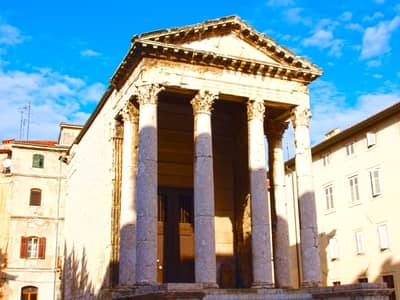
Forum Pula
The Forum was the nucleus of city life, its religious, administrative, legislative and commercial center. On the northern part of the Forum stood two twin temples and a central one dedicated to Jupiter, Juno and Minerva. Today only the Temple of Augustus has been fully preserved while of the second temple only the back wall, built into the Communal Palace in the 13th century, is visible. Ancient remains of the Forum have been found during the construction of new buildings, the latest ones being "Agrippina and her time" (1st century AD). The remains have been partly restored and are now exhibited in the bank built on the site. Even today the Forum is the administrative and legislative center of the city. During the summer months it is the venue for numerous cultural events.
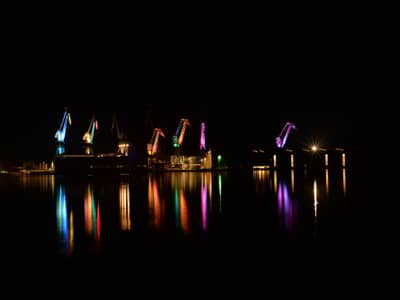
Lighting Giants
Don't miss Pula's latest attraction, a stunning lighting display at the city's circa 1856 Uljanik shipyard, one of the world's oldest working shipyards. Renowned lighting designer Dean Skira has lit up the shipyard's iconic cranes in 16,000 different colour schemes, which come alive four times every evening on the hour, starting at 9pm for 15 minutes.
Triumphal Arch of Sergius
The gate and wall were pulled down in the beginning of the 19th century as a result of the city expansion outside the city walls. The Arch was constructed in Corinthian style with strong Hellenistic and Asia Minor influences both in the method and ornaments. As the eastern side was not visible it has remained for the most part uncarved, while the western, town side is richly decorated. Today numerous cultural performances, theatrical and musical, are held on the square next to the Arch. The adjacent street is a shopping area.
_thumb_400x300.jpg)
04
Ambrela
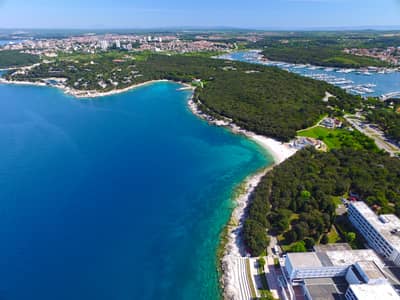
Beach Ambrela is placed right at the entrance into the tourist zone Verudela. Because of its cleanliness and exceptional water quality, it has been awarded the Blue Flag. It attracts especially families with children beacause it has an accesible entrance into the sea . On the beach you can rent deck- chairs and parasols, and there can be found cabins and showers. It’s possible to rent different water and beach sports equipment.The lifeguard service oberves swimmers throughout the day in order to keep all the simmers safe. In the sea has been set the swimmers sea border line. A few meters from the beach, you can find shade as well as two snack bars where you can always refresh.
Brioni
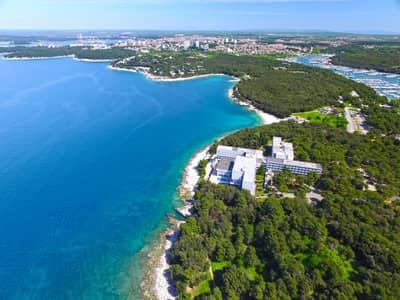
Gortanova Uvala
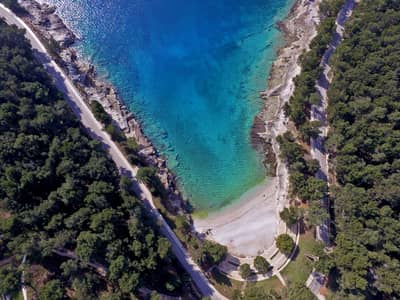
Hawaii
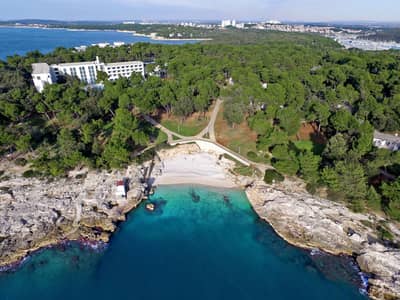
Histria
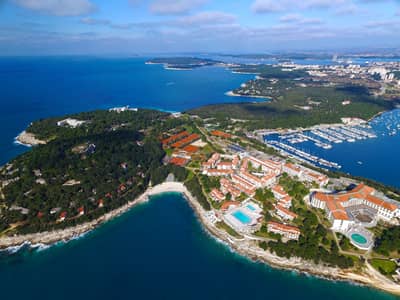
Puntizela
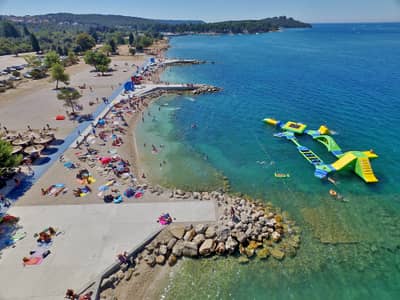
Stoja
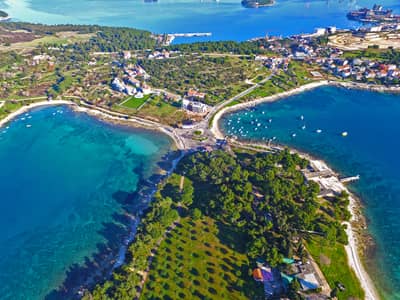
Valkane
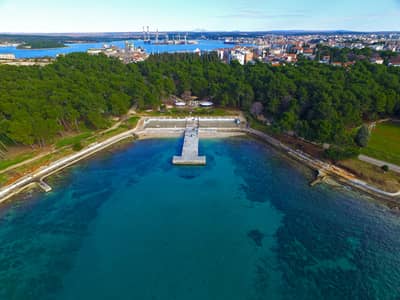
08
Crkva i samostan Sv. Franje
On the slope of the hill between the Forum and the upper circular street, lies the monastic complex dedicated to St. Francis of Assisi, built in the 14th century at the site of a previous cultic edifice.
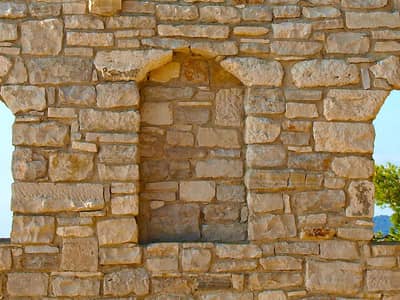
The Franciscan community was first recorded in Pula in the 13th century. The church was built in 1314 in the late Romanesque style with Gothic ornaments, as a firm and simple building of the preaching Franciscan order. The finely cut stone blocks used for building the walls speak of the skilful masters who took part in the construction.
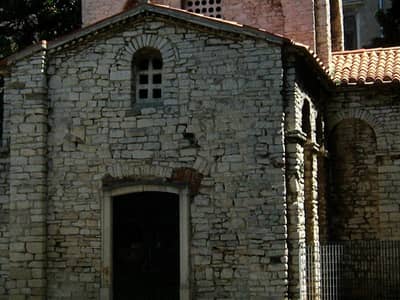
Kapela Sv. Marije Formoze
It is one of the two chapels built in the 6th century as part of a large Benedictine abbey demolished in the 16th century. The floor and walls were decorated with mosaics, some of which are now in the Archaeological Museum of Istria.
It was built in the style of Ravenna churches, the only difference being the use of stone instead of brick. Due to its dimensions, method of construction and good state of preservation, the Chapel represents an extraordinary architectural masterpiece of its time.
Katedrala uznesenja Blažene Djevice Marije
Within the city, along the main street that from Flavia Street leads to the Forum, stands the Cathedral of Pula. It was built at the site where Christians gathered already in the time of their persecution (until the 4th century).
With the ages it grew larger and assumed its present-day shape in the 5th century. It had an elongated oblong shape whose interior was divided by two rows of columns. The area around the altar was in the north, defined by a semi-circular podium with stalls for the clergy. In front of the altar area, behind it and around the very altar, still lie fragments of the floor mosaic from the 5th – 6th centuries, with memorial inscriptions of worshippers who paid for the decoration of the specific surface. The oldest preserved remains of the church wall from the beginning of the 4th century can be seen from outside: the lower part of the rear wall belongs to this period. Due to a fire in 1242 the church underwent reconstruction on several occasions. While the upper windows of the nave were built in the early Christian period, the windows of the aisles bear typical Gothic traits. In front of the church, a baptistery, cross-shaped by ground plan, was built in the 5th century. It was destroyed in 1885. In the beginning of the 16th century a new late Renaissance facade was built, and in front of the church, a belfry was erected in the second half of the 17th century (1671-1707). Stone blocks from the Amphitheater were used for its construction. At the site of the present-day park, east of the Cathedral, until 1657 stood the church dedicated to the patron saint of Pula, St. Thomas. This church too, was built in the 5th century and such twin ecclesiastical complexes were no novelty in Istria (Nesactium, Poreč). After its destruction in the Middle Ages, St. Thomas’ Church was not reconstructed; its surface remains were last evident back in 1812.
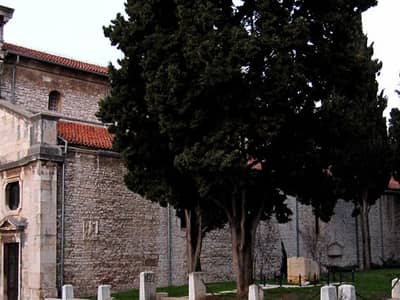
Pravoslavna crkva Sv. Nikole
Built in the second half of the 6th century, with a typical Ravenna-like polygonal apse, the church was dedicated to the Blessed Virgin Mary.
After its radical reconstruction around 1200, it was assigned to the Greek Orthodox community in Pula in 1583 formed by immigrants from Cyprus and Nauplion: Today it belongs to the Serbian Orthodox church. It keeps the iconostasis of the Greek master Tomios Batos from the 18th century, valuable icons and other objects.
04

Více o Pule
zjistit více
Město Pula je skutečný klenot. Během jediné procházky malebnými uličkami propadnete kouzlu středověkého umění a dávných příběhů, které vám budou šeptat starobylé kamenné budovy. Pokud chcete proniknout hlouběji do historie tohoto krásného města, můžete navštívit některé z místních muzeí: Historické a Námořní muzeum Istrie, Archeologické muzeum, podzemní galerie, Muzeum moderního umění, galerii Nejsvětějšího srdce a mnoho dalších.
Zvláště v letních měsících je Pula dějištěm mnoha festivalů, například filmového festivalu, který se odehrává v římském amfiteátru. Zúčastnit se můžete také festivalu umění a hudby a Mezinárodního divadelního festivalu mladých. Milovníky kultury jistě nadchne Odyseovo divadlo na Brijuni, Mezinárodní festival alternativního divadla a Seasplash festival. Pokud dáváte přednost výtvarnému umění, nenechte si ujít návštěvu galerie Cvajner, městské galerie, Klubu mladých, galerie Milotic, MMC Luka, Nemes, Okvir (konstrukce), staré město, Vincenta z Kastavy a mnoho dalších.